



Apple unveiled the iPhone 5 ten years ago, which, unlike previous generations, lacked the 30-pin connector and was released to the market with the Lightning port. Thanks to the use of this port, users could insert the cable into the phone’s port regardless of the correct orientation. This is while, before Lightning, there was only one correct orientation for other ports.
But this port, which was once considered an attractive innovation, has now drawn the ire of many users who are demanding the migration of the iPhone to USB-C. But overall, Apple is one of the companies that is in no hurry to use new technologies. Below, we will discuss 6 technologies that Apple adopted later than its competitors.
USB-C; 8 Years

This feature has not been implemented yet, but due to the new European Union regulations, Apple has no choice but to use the USB-C port for the 2023 iPhones. This law will be enforced starting from mid-2024, but analysts believe Apple will not take a risk in this area and will use the USB-C port for the iPhone 15 series starting in 2023.
Alongside the European Union, the United States and Brazil are also seeking to pass new laws mandating the use of the USB-C port for all phones. The first Android phone equipped with this port hit the market in 2015, which means next year Apple will join this trend 8 years later than its competitors.
It should be noted that the iPad Pro was released with a USB-C port 5 years ago, and despite the continuation of this trend for other iPad models, the company is strongly resisting ditching the Lightning port. In the meantime, we should also mention the 12-inch MacBook, which arrived in users’ hands with a USB-C port in 2015.
Sensor Pixel Binning Technology; 4 Years

After years of using a 12-megapixel main camera for various models, Apple this year launched the iPhone 14 Pro models with a camera sensor based on pixel binning technology.
For years, the Nokia 808 held the record for the highest mobile camera resolution with its 41-megapixel camera. In 2018, Huawei unveiled the P20 and Mate 20 phones with a 40-megapixel camera and came close to this record. Finally, in late 2018, Huawei and Honor introduced the first phones with a 48-megapixel camera.
One of the most important features of the Huawei P20 Pro camera was its use of pixel binning technology, which, besides improving photo quality in low-light environments, offered advantages such as the ability to capture HDR photos without the need to combine multiple different photos. It should be noted that the Nokia 808 camera sensor had a very large size in addition to high resolution. The sensor of this phone was so large that the sensor of the iPhone 14 Pro models is now considered almost the same size.
5G Internet; 1.5 Years

The iPhone 11 series phones were released in 2019 with 4G models, and finally, Apple turned to using a 5G modem for the iPhone 12 series. The main reason for this delay is not related to Apple’s usual stubbornness in using new technologies. Rather, this issue goes back to the disputes between Apple and Qualcomm and Intel’s failure in this field. Ultimately, after Intel conceded defeat in the field of 5G modem manufacturing, Apple and Qualcomm also put aside their legal disputes and signed a cooperation agreement once again.
During that period, rumors circulated about the iPhone using modems from Samsung, MediaTek, and even Huawei, but these rumors did not materialize. After Intel’s failure, Apple decided to enter this field personally, and for this reason, it acquired the company’s mobile modem division in 2019 by paying $1 billion. Some analysts believed that Apple would start using proprietary modems in 2023, but apparently, the company has faced many challenges regarding modem patents.
The Galaxy S10 5G is considered the first phone based on this technology that hit the market in 2019. Therefore, overall, Apple adopted this feature 18 months later than its long-time rival.
Always-on Display; 6 Years (at least)
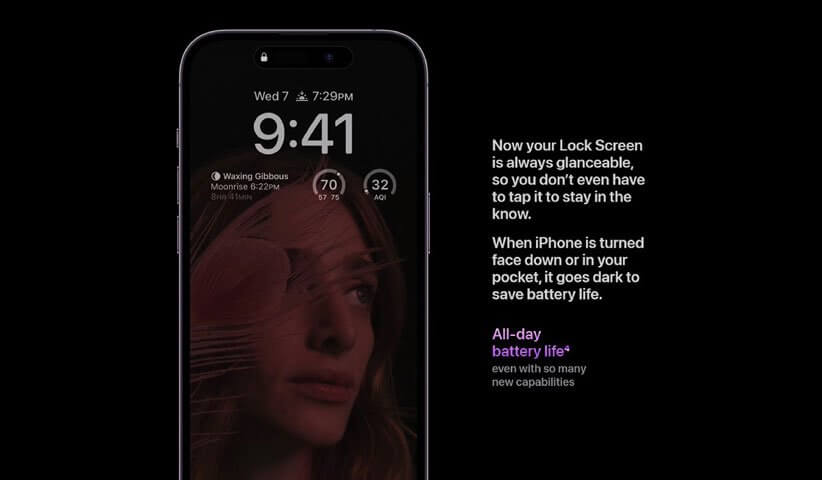
Apple introduced the Always-on Display feature for the Apple Watch 5 in 2019 using LTPO panels for this watch. But this feature has finally made its way to the iPhone 14 Pro models after years of waiting.
Years ago, when most Android phones used LCD displays, these phones could somehow simulate the Always-on Display feature. But apart from these phones, in 2016, phones like the Galaxy S7 and LG G5 hit the market as the first phones based on Always-on Display technology. At that time, activating this feature put a lot of strain on the battery, but in recent years, the energy consumption of this feature has become much better.
Wireless Charging; 8 Years

Like the Always-on Display, the wireless charging feature also made its way to the Apple Watch first. In fact, the first generation of Apple Watch in 2014 also featured this specification. The Palm Pre is considered the first phone equipped with this feature, released in 2009. For a few years, no other phone featured this capability except for this phone and subsequent generations.
But ultimately, phones like the Nokia 920 and Nexus 4 also reached users in 2012 utilizing wireless charging. Initially, phones used two different standards for wireless charging, but eventually, different companies agreed on using the Qi standard.
In 2017, Apple unveiled the iPhone X and iPhone 8, and these phones were equipped with wireless charging. In 2020, MagSafe technology also arrived, which allows users to charge their iPhones magnetically.